
From burnt out cars in 2000 to a thriving space for nature in 2025. What will the next 25 years bring for Gipton Wood?
Back in 2000, Gipton Wood was known for burnt out cars and discarded sofas. Local people came together and created Friends of Gipton Wood. They cleared the fly tipping and litter, restored and improved paths, and fundraised to rebuild the Roundhay Road steps. Since then, the Friends have continued to look after the Wood, maintaining a thriving space for nature and people in the heart of the city.
Twenty-five years on, more work is needed. We want to make a once in a generation investment to renovate, update and enhance this special ancient woodland, to ensure it will continue to thrive for nature and our community for the next twenty-five years.
Our plan aims to make Gipton Wood safer, more accessible and more valuable for nature, all while conserving its heritage, as set out in the sections below.
Have your say
We would like your views on this plan before we apply for funding to carry out the work.
Click the green bars below to read each section to learn more about the proposals and view plans, designs and other documents and photos.
Then share your feedback using the survey at the bottom of this page. The survey closes at midnight on Sunday 15 February 2026.
If you have any questions about our plans, we are holding a Q&A event on Saturday 7th February, or you can contact us.
Overview
We want to carry out the work that is needed to set Gipton Wood up for the next twenty-five years.
This includes:
- Major renovation and upgrades to the infrastructure in the Wood. Proposals include improving paths, upgrading entrances, and installing benches and information boards, to make the Wood safer, more accessible and to conserve its heritage;
- Enhancing nature and wildlife. Proposals include ecological enhancements and some tree works to ensure the Wood stays in good condition and new trees and plants can grow in a healthy way.
We hope to win funding to do all this work at once. However, we may have to make multiple bids and conduct the programme of work over several years.
Masterplan
Our masterplan consists of three maps:
- the main issues to resolve within the Wood,
- the proposed works to resolve those issues, and
- the proposed changes to each entrance.
The proposed works fall under four themes:
- safety,
- accessibility,
- nature conservation, and
- heritage conservation.
You can download the masterplan containing the three maps to refer to as you read about each theme in the following sections. Further downloads with specific details are available under each section.
Downloads
From Community Survey…
In 2023 we asked you, our community, how you would like to see Gipton Wood improved for the future. We did this through the Your Gipton Wood community survey. You told us that safety, accessibility, nature conservation and heritage conservation were the most important issues.
We discussed these priorities with Leeds City Council (LCC) and built them into our five-year management Plan. This was agreed with LCC and approved by the Friends at the 2024 Friends of Gipton Wood Annual General Meeting (AGM).
However, it was clear that we wouldn’t be able to do everything through our Volunteer Action Mornings and that LCC would not be able to fund everything. So that year we started to develop our proposals to bring your vision, our community’s vision, to life.
…to this plan
We were awarded grants from Morley Glass and Roundhay Environmental Action Project to commission an ecology survey. This helped us better understand how we could support plants, fungi and wildlife in the Wood. We also met with different Council departments and the West Yorkshire Archaeology Service to make sure the plans help protect the Wood’s heritage.
In April 2025, the Friends agreed an outline proposal at our AGM. With support from Leeds City Council, we then secured funding from Wade’s Charity. This allowed us to commission Groundwork to develop the proposal into a detailed plan.
Why
Safety is a key focus of this plan because it was the biggest concern raised in the community survey.
A major concern raised by the community is quadbikes and motorbikes entering the Wood, often at speed, putting others in the Wood at risk.
Also, over 25% of respondents in the community survey wanted better lighting on the tarmac path from Roundhay Road to Copgrove Road.
In addition, the tarmac and sandstone paths were installed around 20 years ago and are now wearing out. Over the past year, several trips, slips and falls have been reported as the paths have become uneven and pot-holed.
proposals
We have started improving safety through volunteer sessions. We have been taking out younger trees (saplings) next to paths to reduce leaf cover and increase light levels. We have also started building a dead-hedge along the Copgrove Road boundary and laying the hedge along the Oakwood Boundary Road.
In addition, we have four proposals to improve safety in the Wood:
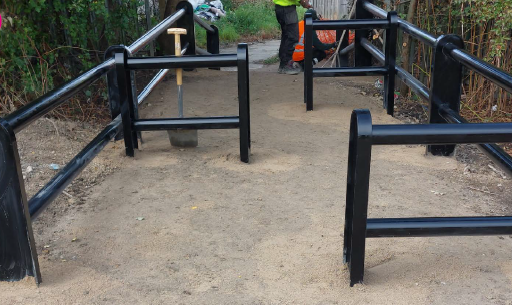
- Install chicanes or bollards at every entrance to prevent quadbikes and motorbikes from entering the Wood as far as possible, certainly not at speed. These will still allow access for pedestrians, pushchairs, bicycles and wheelchairs.
- The chicane design is Disability Discrimination Act (DDA) compliant and approved by Leeds City Council.
- The third page of the masterplan shows which chicane or bollard design will be used at each entrance.
- We also have drawings of what the chicanes and bollards will look like, a photo of a similar chicane from another Leeds park, and specific drawings of the entrances at Oakwood Drive and opposite Gipton Wood Place where the design is adapted to suit the location.
- Add at least one additional lamppost to the main tarmac path between Copgrove Road and Roundhay Road to remove dark spots.
- Repair and improve all the main paths in the wood, further detailed in the ‘accessibility’ section below.
- Naturally increase light and visibility within the Wood by carrying out “halo thinning” in key areas of the Wood. This involves carefully thinning trees around selected mature trees. This work is explained in more detail in the Nature Conservation section below, but it will also improve safety by:
- reducing leaf cover,
- increasing light levels, and
- improving visibility along paths and across the Wood.
Downloads
- Site Proposals Plan (Masterplan page 2)
- Access Control Plan (Masterplan page 3)
- Chicane design
- Bollard design
- Chicane example
- Oakwood Drive chicane design
- Gipton Wood Place chicane and access gate design
Why
Accessibility was the third biggest concern from the community survey.
The main priorities were:
- paths that are worn, uneven or slippery, and
- better access for wheelchairs and pushchairs.
People also mentioned low lighting at night and quad/motorbikes in the wood, which are covered in the ‘safety’ section.
Some respondents were keen for the Roundhay Road steps to be made accessible – we have carefully looked at several options and unfortunately this is just not possible at that point in the Wood.
At our engagement events, such as at the Oakwood Farmer’s Market, we are often struck by how many local residents have never been into the Wood. We are often told that they don’t know where the entrance is, or feel it is unwelcoming because of the stone wall and the wall of trees.
Proposals
There are four proposals to address these issues. These are alongside ongoing volunteer-led activities to maintain paths and entrances by cutting back vegetation and removing leaflitter and moss as far as possible.
- Create a fully accessible circular route in the flatter, north-eastern part of the Wood.
- This route meets Disability Discrimination Act (DDA) standards.
- The route is shown as a blue dotted line on page 2 of the masterplan. It will:
- start from the green arch entrance at the end of Gipton Wood Road, close to easy parking,
- form a loop so people can enjoy the Wood without needing to retrace their steps, and
- connect to the southern entrance near Copgrove Road and Gipton Wood Avenue / Upland Grove.
- To create the route, we will remove a Sycamore tree that has grown in the middle of the path in the eastern corner. This is different to the Hornbeam tree most prominently in the middle of the path in that corner which will remain.
- There will be new benches at regular intervals, information boards and sculptures to make this a destination route, encouraging people to visit the Wood rather than just to pass through it. For examples, see pictures on the lefthand side of the masterplan proposals page.
- Improve and renovate the green arch entrance from Copgrove Road, at the end of Gipton Wood Road.
- The entrance will be redesigned, as part of the accessible route, to create a small entrance plaza.
- The area will be surfaced, include a sitting wall and welcome board.
- It will mirror the Roundhay Road steps with mosaic inserts designed by local children.
- Upgrade the rest of the main paths and resurfacing the tarmac paths.
- The current tarmac paths (marked in grey on the masterplan proposals page) will be resurfaced with tarmac.
- Paths marked in yellow on the masterplan proposals page will be resurfaced with HopPath. This is a recycled aggregate with resin additive to create a porous but firm surface. It is already used in other parks around Leeds as in this photo.
- These upgrades will make it easier for everyone, but especially those with lower mobility, to walk safely in the Wood with less risk of trips and slips.
- Smooth paths will also make it easier for wheelchairs or pushchairs.
- Create a new entrance from the Oakwood Parade at the bottom of Oakwood Boundary Road opposite Rico’s.
- This new entrance and path will come up to the path junction where the central spine path meets the path heading east up to the Scheduled Monument. This is shown on the proposals page of the masterplan.
- Though the gradient makes it unlikely to be fully wheelchair accessible, this will provide a step-free, less steep (and less cobbled!) route into the Wood from Roundhay Road and the Oakwood Parade. This improves accessibility for those with reduced mobility and pushchairs.
- There is also the option to create a picnic bench area, using the base of an old substation. This would open this area up to make the Wood more inviting, as well as giving people a new and more obvious way into the Wood.
- To mirror the other main entrances into the Wood, this would include mosaic inserts designed by local children, a welcome board, and a green arch entrance made reusing the original railings that would need to be removed.
Downloads
Why
Almost 80% of community survey respondents said they used the wood to connect with nature.
Gipton Wood is an ancient woodland with many precious and rare species. They need looking after to survive and thrive.
In our recent ecology survey, Gipton Wood was classed as approaching ‘good condition’, thanks to all the work of many volunteers over the decades. Well done volunteers! The survey also made suggestions for how we could enhance the Wood for nature, including improving biodiversity.
Proposals
There are six main proposals that address the recommendations of the ecology survey. These proposals are mapped in the biodiversity plan, and sit alongside the ongoing volunteer-led thinning of saplings across the site to improve regeneration.
- The first three proposals listed below will be carried out by contractors as part of the programme of works.
- The second three will be undertaken by volunteers over time, with some initial work done as part of the programme of works.
- Improve the woodland edge along Roundhay Round by removing some trees between the Roundhay Road steps and the Oakwood Boundary Road (at Rico’s).
- The aim is to create a ‘scalloped’ (curvy) edge. This will encourage rare plants such as wood sorrel and field garlic to recover by:
- letting more light reach the woodland floor at the edge of the Wood, and
- reducing the amount of leaves falling on that section.
- See page 15 of the ecology survey for more details.
- The aim is to create a ‘scalloped’ (curvy) edge. This will encourage rare plants such as wood sorrel and field garlic to recover by:
- Carry out ‘halo thinning’ across the Wood to protect mature trees and promote stronger regeneration.
- This means choosing mature trees that we want to protect and then removing a few trees and saplings around them to give them more space.
- This will help the mature trees thrive by reducing their competition for light and nutrients and also allows more light to reach the woodland floor improving regeneration.
- Older trees are important habitats for rare insects, plants, fungi, bats and birds.
- At the moment, the height and density of the canopy in the Wood, means that younger trees grow tall and thin, weakening the next generation of trees. More light will mean they can grow slower and stronger.
- See page 15 of the ecology survey for more details.
- Create raised pathways over wet ground near the green arch entrance off Copgrove Road.
- This would allow water to pool beside and flow underneath a raised path. This creates a new wet habitat and keeps the path drier and easier to use.
- See page 20 of the ecology survey for more details and the proposals page of the masterplan for the location.
- Restore wet habitat in the gully by slowing the flow of water, retaining more water in that area.
- We propose to create ‘leaky dams’ made from tree branches or trunks. This slows the flow of water and creates new habitats for wildlife.
- See page 20 of the ecology survey for more details.
- Improve the woodland understorey.
- The ‘understorey’ of the Wood is made up of smaller trees and shrubs beneath the main canopy. This improves the diversity of habitat in the Wood for birds and beasts.
- We propose to plant more wildlife-friendly smaller ‘understorey’ trees, such as Hazel, Hawthorn and Rowan.
- See page 15 of the ecology survey for more details.
- Protect plants by laying logs and branches along path edges.
- Some paths have got very wide over the years from walkers trying to escape the mud!
- Alongside improving paths so they are less muddy, edging them with logs will protect more space for plants to grow again, especially our beloved bluebells.
- See page 18 of the ecology survey for more details.
Downloads
- Ecology survey
- Biodiversity plan
- Site Proposals Plan (Masterplan page 2)
Why
Over half of respondents to the community survey thought conserving the Scheduled Monument in the Wood was important. The monument is a Bronze Age ring ditch. Previous work improved paths and created a route around the monument. However, it is still being worn away.
Also, over 60% of survey respondents wanted more information available to the local community about the history and heritage of the Wood.
Proposals
There are three proposals to address these issues.
- Upgrade all paths crossing the Scheduled Monument to prevent erosion.
- This is detailed in the accessibility section, but sections of path that cross the ring ditch will be a particular focus.
- We will ensure the paths are properly built up to protect the ditches from further erosion.
- See the proposals page of the masterplan for the location of these paths.
- Remove small paths crossing the ring ditch and banks.
- There are two small paths (often called ‘desire lines’) that cross the ring ditch unnecessarily.
- Volunteers will close or divert these paths away from the ditches providing alternative routes to prevent erosion.
- You can compare the location of paths around the Scheduled Monument on the analysis and proposals pages of the masterplan to see which paths will be affected.
- Install information boards at key locations across the Wood.
- Information boards are common in other parks and green spaces across Leeds but are currently missing from Gipton Wood.
- The boards will share information about:
- woodland plants, especially bluebells,
- birds and other wildlife,
- trees,
- the Scheduled Monument, and
- the gully and the adit from the old Gipton Pit and local mining history
- An example of an information board can be seen on the left-hand side of the proposals page of the masterplan.
Downloads
- Site Proposals Plan (Masterplan page 2)
- Site analysis (Masterplan page 1)
- Information Board example